
We always take care of your smile

Inlays and onlays are restorations applied to posterior teeth that are too decayed or fractured to receive a regular filling. They often cause less removal of tooth structure compared to crowns. Since they are fabricated in a laboratory from impressions taken from the tooth, they are also known as indirect restorations. They are made from a special composite filling material or porcelain.
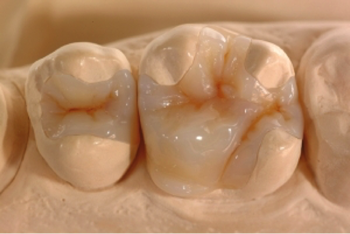
What are Inlays and Onlays?
Inlays and onlays are treatments applied to teeth with significant loss of tooth structure that cannot be restored with conventional fillings and when the patient does not prefer a porcelain crown. They provide a solution between a filling and a crown. Using the existing tooth structure, impressions are taken, and porcelain inlays and onlays are prepared in a short time and bonded to the tooth surface. This approach also protects the gums and ensures better color harmony among the teeth. Because they provide a more polishable surface than standard fillings, food accumulation is significantly reduced.
How are Inlays and Onlays Applied?
Cavities or fractures in the tooth are cleaned, and smooth surfaces are prepared. An impression of the teeth is then taken, either using traditional trays with silicone material or using digital dentistry techniques with intraoral 3D cameras, which is transferred to a computer. The missing part of the tooth is then reconstructed with porcelain material, shaped by computer design, and the prepared porcelain inlay or onlay is bonded to the tooth.
Why Are Inlays and Onlays Preferred?
Porcelain inlays and onlays are more aesthetic than other fillings, and the junction between the tooth and restoration is barely noticeable. They are recommended for patients who desire high-quality aesthetics and comfort. They are preferred in cases where preserving as much tooth structure as possible is important (instead of using a crown).
How Long Do Inlays and Onlays Last?
The lifespan of inlays and onlays depends on the material used, the patient’s oral hygiene, the skill of the dentist, and the intensity of chewing forces on the tooth.
What Are the Advantages of Porcelain Inlays and Onlays?
Their biggest advantage is the perfect contact with adjacent teeth, which prevents food from getting trapped between teeth and helps maintain gum health in the long term. Another advantage is the lower risk of problems like fracture or dislodgement, and they provide highly aesthetic results.
Are There Any Risks? What Should Be Considered?
Inlays and onlays have minimal risks. However, if saliva is not properly isolated during the procedure, the restoration may not bond well and could fall off later. Like other restorations, they can break under excessive force.
We always take care of your smile
+90533 302 77 78
Dentamar Oral and Dental Health Polyclinic Services © 2025 | All Rights Reserved. Crow Digital Agency
