
We always take care of your smile

After a large cavity is cleaned or a root canal treatment is performed, the remaining healthy tooth structure may not always be sufficient for a composite filling.
In such cases, placing a crown requires reducing or removing some of the remaining healthy tooth structure. In contrast, inlay/onlay/overlay or endocrown restorations preserve the remaining tooth tissue while restoring the missing parts of the tooth. This makes the tooth more durable and functional. Since they are prepared on a model in a laboratory, they are much more compatible with adjacent teeth and tissues compared to conventional fillings placed directly in the mouth. Contacts are improved, which minimizes problems such as food accumulation between adjacent teeth. Color matching is very good. They also provide a better-polished surface than standard fillings, resulting in less food residue accumulation.
They serve as a solution between a filling and a crown.
Inlays/onlays/overlays or endocrowns are made of hybrid composite or porcelain.
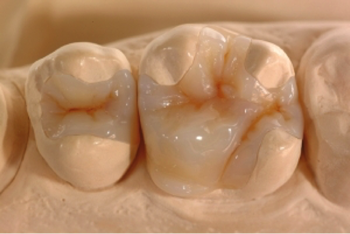
How is an Inlay/Onlay/Overlay/Endocrown applied?
The decay or fractures in the patient’s tooth are cleaned, and smooth surfaces are prepared. An impression of the patient’s teeth is then taken. This can be done in two ways: either by placing trays in the mouth and using silicone materials, or by using digital dentistry techniques with intraoral 3D cameras, transferring the measurement to a computer. Then, the restoration is fabricated in the laboratory or digitally using materials such as porcelain or hybrid composites. The prepared inlay/onlay/overlay/endocrown is bonded to the tooth to restore the missing part of the surface.
Why is Inlay/Onlay/Overlay/Endocrown preferred?
These restorations are more aesthetic than regular fillings and fit very well with the tooth. They are recommended for patients who want to preserve tooth structure and have aesthetic expectations.
How long does an Inlay/Onlay/Overlay/Endocrown last?
Its longevity depends on the material used, the patient’s oral hygiene, the dentist’s skill, and the intensity of chewing forces on the tooth.
What are the advantages of Inlay/Onlay/Overlay/Endocrown?
The main advantage is excellent contact with adjacent teeth, which prevents food from getting between teeth and helps maintain gum health over time. Another advantage is the lower risk of problems such as dislodgement or fracture. Additionally, very aesthetic results can be achieved.
What should be considered in Inlay/Onlay/Overlay/Endocrown applications?
Although these restorations have minimal risks, if saliva is not adequately isolated during placement, the restoration may not bond properly and could fall off later.
We always take care of your smile
+90533 302 77 78
Dentamar Oral and Dental Health Polyclinic Services © 2025 | All Rights Reserved. Crow Digital Agency
