
We always take care of your smile

The appearance of the gums is also extremely important for teeth that look natural, healthy, and aesthetic. The healthy form, symmetry, and color of the gums are crucial for designing a healthy and beautiful smile.
Smile Design refers to a series of dental treatments aimed at giving you a healthier and happier smile. Smile design may include:
Teeth Whitening
Pink Aesthetics (Gingival Aesthetics)
Laminate Veneer (Veneer Tooth)
Zirconium
Implant Applications
Orthodontic Treatment
Cosmetic adjustments
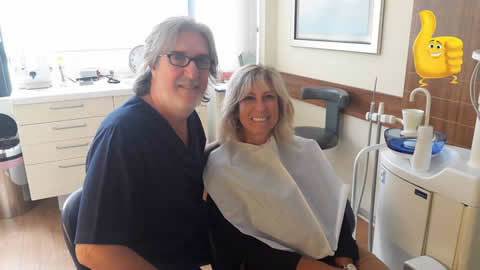
Image 1: Our patient welcomed in our clinic together with our dentist.
Excessive gum visibility while smiling or speaking (“gummy smile”) significantly affects facial aesthetics.
For this reason, the position, shape, form, and discolorations of the gums can be easily corrected through surgical methods. In these procedures, either laser or conventional surgical techniques can be performed under local anesthesia.
Small interventions on the gums alone can create significant changes in facial aesthetics.
Before aesthetic porcelain applications on the front teeth, the gums must be evaluated and, if necessary, surgically corrected. Performing this procedure provides a significant contribution to the aesthetics of the porcelain restorations.
Most Commonly Used Methods in Dental Aesthetics:
Porcelain Laminate Veneers
Full Ceramic Crowns and Bridges
Onlays (Porcelain Fillings)
1) Porcelain Laminate (Veneer) Veneers:
In modern dentistry, aesthetics has become increasingly important. With the development of adhesive technologies, allowing maximum preservation of tooth tissues, porcelain laminate veneers have started to be frequently preferred for anterior teeth. Laminate prostheses, derived from the Latin word meaning “leaf,” are very thin porcelain sheets bonded to the front surface of the tooth with special adhesives.
They are applied in cases where teeth whitening does not achieve the desired results, in congenital structural anomalies, to close gaps between teeth (diastema), in midline discrepancies, in patients who do not want orthodontic treatment, for mild crowding, in broken or worn teeth, and in teeth with poor, unhealthy, or old restorations, as an alternative to full crowns.
Porcelain laminate veneers, which can be applied to almost every patient group, cannot be used in patients with parafunctional habits (nail biting, pencil biting, teeth grinding).
They are increasingly preferred due to their advantages, such as requiring minimal tooth reduction (0.3–0.5 mm) or none at all, durability, and color stability.
2) Full Ceramic Crowns and Bridges:
Full ceramic crowns and bridges are applied as crown prostheses in cases of tooth loss, for the construction of bridges, and in teeth that have suffered significant tissue loss due to decay, fractures, or wear. They are also used for correcting aesthetic anterior tooth irregularities. These restorations do not use metal in their substructure.
Although metal-supported ceramic restorations have been successfully used for many years, they have several disadvantages. These include the possibility of metal allergies, color changes in the ceramic due to metal content, removal of more tooth tissue for both metal and ceramic, lack of light transmission through the metal, and inability to achieve a natural appearance. For these reasons, metal-free full ceramic restorations have been developed.
They are biocompatible with teeth and surrounding tissues, replicate tooth structure and color very well, and do not cause dark discolorations in the gums caused by metal. Full ceramic crowns, due to their translucency, are the most natural-looking type of crown, closely resembling our own teeth.
3) Onlays (Porcelain Fillings):
Onlays are used in the restoration of teeth that have lost a significant amount of structure due to decay or fracture, or when the upper structure of the tooth has weakened as a result of root canal treatment. They are applied in cases where the tooth is too damaged to be restored with a regular filling but can be treated without removing as much material as in a crown restoration. This allows for maximum preservation of healthy tooth tissue.
In the first session, the decayed parts of the tooth are cleaned, and the appropriate cavity shape is prepared. An impression is then taken and sent to the laboratory. The custom-made porcelain filling is bonded to the tooth with special adhesives in the following session.
These porcelain fillings have a hardness similar to that of natural teeth, helping to preserve the health of the tooth and surrounding tissues. They are resistant to chewing forces, aesthetically pleasing, and long-lasting.
We always take care of your smile
+90533 302 77 78
Dentamar Oral and Dental Health Polyclinic Services © 2025 | All Rights Reserved. Crow Digital Agency
